Monday, October 24, 2011

Occupy the Food System

"In the Food Movement we re-learn and re-invent ways of farming, cooking and eating. In doing so, we put back in the social, economic and cultural values robbed by the industrial food system."

The recent Occupy Wallstreet and its subsequent solidarity movements have garnered media, political, and household attention. Occupy has naturally occupied the minds of people from all walks of life as you expect a movement representing 99% of the US population would. My Oma and Opa recently visited our house for dinner and occupy became the subject of one dinnertime discussion. As I sat over the meal my mother and father had lovingly planned and prepared with local and organic ingredients, it struck me that my parents and grandparents, though not physically occupying anything but a table with a tasty meal, felt a kind of kinship with the occupiers because they fought, and still fight, to build better lives for themselves and their families. As immigrants and first generation college students, these two generations have experienced improved quality of life very differently. My grandparents often associated improved quality of life with a better income, better health, and more social capital. My parents, while also citing higher income, talked about more freedom. Freedom from debt, freedom to work in their chosen fields, freedom to be intellectually and artistically creative, and free time.

Like my family, activists from everywhere are thinking about what occupy means to them. For advocates of alternative food systems, occupy means food sovereignty through policy change. A recent article, Occupy the Food System! by Eric Holt Gimenez (Executive Director, Food First/Institute for Food and Development Policy) very nicely outlines why, as Americans, occupying our food system is necessary to "build a better society," occupy's only stated mission. He asks the question: if community garden and school lunch reform work so well, why isn't everyone gardening for the future? Well, quite honestly, because money and politics control the extent to which our communities can be autonomous and self-sustaining. So many organizations with programs aimed at improving the food system are dependent on government funding streams. Many times, these organizations tweak their missions to maintain funding, drifting further from the "alternative" in alternative food system. Gimenez believes that the strength of the occupy movement lies in "unifying and amplifying popular voices around a shared vision." This, he says, is much more effective than the many, spread out, lone voices of community food organizations all over the country.

Tom Philpott of Mother Jones really puts the importance of a unified front in perspective with his rundown of the American food system, tagline: "Because Big Food makes Big Finance look like amateurs." The overarching message to take away from this article is, less than 10 companies have America's proverbial balls in a vice and they just keep tightening their grip. Philpott lists four reasons to make food policy part of the occupy agenda:
  1. The food industry is a big fat monopoly.
  2. The food industry screws farmers, its own employees, and the environment.
  3. Wall Street's greed leaves millions to starve—literally.
  4. Our politicians are in bed with agribusiness
The global food market is just as subject to speculation as real estate or stock exchanges. Market prices are often "guesstamated" using a special bank-made financial instrument called the Goldman Sachs Commodity Index. Many people placed their bets and, just like the housing bubble, wall-street engineered a "food bubble" and then burst it, leaving clients pennies poorer and thousands starving while banks like Goldman Sachs and AIG counted their winnings. Corruption never tasted so sweet.

So, what does this have to do with apartment gardening? I am a proponent of self-sufficiency and I feel that gardening, especially for those of us with little money and land, can offer small amounts of that. Similarly, home gardeners are often affected by local policies that prevent us from growing food, especially when we are renters or apartment dwellers. These are the policies Gimenez spoke of that are designed to make us dependent on a flawed food system. For those of you interested in occupy the food system, there are several places to go for information:
1. http://www.facebook.com/OccupyTheFoodSystem
2. http://www.foodfirst.org/en/Occupy+the+food+system
3. I also suggest taking your concerns to your local occupy General Assembly.

In Tampa, try visiting the Food Day Soiree on 10/30, join the Bird House Buying Club or Tampa Urban Food Forum, or get involved with the The Seminole Heights Community Garden, Sweetwater Farm, Create a Healthier Sulphur Springs for Kids, or Moses House Youth Garden to meet like minded people.

If you know of any more groups, please post them in the comments section.

Saturday, October 1, 2011

The Amateur's Dilemma: Edibles and Idioms

My friend Jenn (pictured left on a joyride) recently wagged her virtual finger at me for failing to update more often. I can't help but agree. I've neglected this sweet little blog for far to long. Unfortunately, in my world this is par for the course. I have a nasty habit of starting projects with the best intentions and then not prioritizing them properly. For now, I will blame graduate school and a failed garden for my lack of updating. While I always wanted to document the successes and failures of apartment gardening, when the failures outpaced the successes it became to depressing to document.


However, that was last season and this is this season. Slowly but surely, I am getting my fall planting underway. Little bits at a time I've started some pole beans and peas, tomato plants, and squash. Just a note, gardening in Florida follows a different pattern than the rest of the country so my planting schedule may be unlike your own. Every thing (knock on wood) seems to be growing really well! I suppose the proof of the pudding is in the eating or the proof of the pole bean is in the eating (proof of the pole bean pictured left)? The point is, I will know how well I've done in just a month or two.

Squash and tomato seedlings

Blueberry Bush

I am really excited about my blueberries this season. Some varieties are Florida natives and they do well in our sandy soil. So, interested in the apartment applications of the blueberry, I've have started an experiment: I've planted one blueberry plant in the ground, and one in a container. One is in potting soil and the other is in the clay-like soil of my apartment complex. I treated both soils similarly with an organic sulphur mixture because blueberries like acidic soil. Both will be mulched shortly and fertilized similarly. I'll be keeping track of how both plants progress. For Florida gardeners, this really is a good resource (taken from the Gardening in Central Florida blog). There is also a nice guide to acidifying soil by the Oregon State University Extension Service. It explains what soil acidity and pH actually is. That concludes the first of regular updates to come!

Wednesday, April 6, 2011

Hasty and Tasty: The tiniest of harvests

It's happened, it's finally happened. I have eaten the spoils of my labor. So, get this: I was able to eat TWO tiny strawberries of my own making, little broccoli heads, a small head of cabbage, and herbs. The herbs don't count though because they pack a huge punch with very little effort.

Below, you will see a hearty breakfast. The giant, chopped, beautiful strawberries are store-bought. If you look closely, just below the eggs to the left of center is the tiny strawberry I grew. I gave this little jewel to Roy and I found a matching strawberry in the plastic container to put on my plate. I lied and told him they were both home grown but only made it through half the breakfast before I broke down and told him the truth. I felt a little inadequate.

I used our small broccoli yield to make a broccoli and cheese quiche which was delicious and satisfying. I actually made two. Roy and I ate one and the other was split and given away as part of our food co-op swap.


Tonight, I was out in the garden doing some pruning and realized that it was time my cabbage was eaten. I pulled it out of the pot and headed inside, resolved to make my cabbage experience as sexy and memorable as possible. Obviously, Irish and German-style cabbage were out of the question although, to be fair, a leafy green that leaves you gassy doesn't exactly scream sultry. I doubt even the French, who somehow made reptiles and fungi seem romantic, could make a lusty cabbage dish. So I turned, as I always do in troubled times, to Indian cuisine. Here's what I did. I chopped up my cabbage, a red onion, and a few garlic cloves. Helpful Hit: I use this Japanese soup spoon to crush my garlic because it has a wide, flat bottom and I'm too scared to use the side of my knife. I've also heard that a large stone is equally as useful for garlic as long as you keep it clean.


Next, I heated some olive oil in my pot and sauteed the onion and garlic. Then, added the cabbage, oregano, and some white balsamic vinegar.


I covered the pot and let it boil for about 15 minutes. When the cabbage became soft, I added some ginger, salt, turmeric and garam masala to the mix and let the cabbage boil for a few more minutes.


I removed the lid to the pot and added the greatest spice known to man kind: butter. I left the pot open so that the liquid would start to boil off and create a creamy sort of sauce and then I added some chickpeas for more texture.


When most of the liquid was evaporated, I dished the mixture into my bunny bowl and ate my sexy cabbage. It was creamy. Yeah, creamy cabbage. It's real.


While all this was going on, I started infusing some vinegar with pineapple sage and orange mint. For instructions, see here.

Monday, February 21, 2011

The Trade Market TM

Remember that time Paris Hilton tried to trademark the phrase "that's hot"? So does everyone else, because it was ridiculous.

I read this morning in treehugger.com that the Dervaes Institute decided to trademark the rather common phrase "urban homesteading". This has naturally raised a few eyebrows as well as a few fists from urban homesteaders around the country. For example, (screen name) CdiWadkar said,

The Dervaes are self-serving arseholes. They should really trademark McDervaes, Urban McSteading and I'm Lovin' Shamelessness. And from now on I'm going to write Urban Homesteading with the Eff You mark at the end - Urban Homesteading (FU)

There are more eloquent reactions available, but none of them really spoke to me like this one. I think this raises a pretty important question that has been looming on the horizon for a few years. Especially for those gardeners who ally themselves with larger political movements, like low impact living, sustainable living, back-to-the-land-movements, and those who wish to separate themselves from the questionable practices of agribusiness, the question should be considered:

Can you simultaneously be an alternative agriculturalist and a businessman without turning into an agribusiness-man TM (that one's mine)?

Well, obviously there aren't a whole lot of pro-bono farmers out there, nor should their be. We all gots to get paid by our trade, right? Legal and governmental systems have been naturalizing this bottom line for thousands of years. Take, for example, feudalism, Yeomen, and cash-grain farming. There were, of course, always ways to work against these systems. Take, for example, centralized power and The Homestead Act. Central to these systems, however, is access to land, and its profitability and ownership. Good land was the key to being fat, wealthy, and upwardly mobile. With good land, one was able to provide food for themselves and for the marketplace. Furthermore, the granting of good land afforded one fealty, while the owning of good land afforded one certain freedoms.

Currently, those of us without much land, or even good land, have found ways to cope and grow food for ourselves. Raised beds, hydroponics, container gardening, community gardens, and living walls are all ingenious ways to grow food in a way that subverts traditional farming techniques, placing a premium, not on land, but on ingenuity. There are a million books, magazines, and youtube videos with how-to urban gardening techniques and projects. There is definitely a market for these diy endeavors, but what will be the consequences of selling subsistence advice? Will urban gardening be something only a few can afford to do or might it become synonymous with a certain income bracket or middle class value that alienates other populations? What are the ramifications of patenting and copy writing traditional knowledge as if it is something novel, not based on years of sharing information and trial and error? They are questions worth pondering.

Thursday, February 3, 2011

No Squirrels Were Harmed in the Making of this Garden

This post is dedicated to the Smubb I love!

We moved. Yes, after all that preparation and hard time, we moved. We moved to a lovely apartment with significantly more patio space but without a screen. Now settled into the new abode, I've started cultivating again. At the mo I have a cabbage, two broccoli stalks, and a broccoli cutting that I salvaged from dinner, soaked in water over night and replanted. Soaking the stalks was not something I've ever heard of but instinct told me it was the right move. It's actually growing! Add to that, several green bean buds, and some baby basil.

Despite the cold, my plants are doing very well. These are all varieties that do well in cold weather and they seem to be thriving so far. The only problem I've had is a crazed squirrel who has made a game of harassing me and my plants. After some exhaustive research (I read a page from a book) I learned the following:

1. Though adorable, squirrels are considered pests in the gardening world.
2. Squirrels are fond of digging.
3. They do not eat the seeds they dig up, they just like to dig.
4. A seedling can only handle being dug up about 3 times before it checks out completely.

Because we have no screen protecting our porch, the squirrel has easy access to my supple seedlings. I arrived home one afternoon and, after a quick potty break, went outside to check my plants. What I found was the evidence of an epic struggle. Green bean seeds and dirt were strewn all over the ground. I replanted them and luckily they have sprouted nicely. Squirrely had also chewed right through the string of twinkle lights I'd hung the day before. Over the next few days I was on a squirrel stakeout and my anal retentive justice vigil payed off because I caught him in the act. As I ran out, he scurried up the side of the building and onto my upstairs neighbor's balcony. I yelled after him, "I know what you did!" and he stopped to flip his bushy tail at me. A final "eff you, biotch" and a promise that he'd be back when I least expected him.

Looking online for solutions yielded some pretty unsavory results including the Squirrel Control Center with solutions like smoke bombs, traps, and ultrasonic devices. I've watched enough Bill Murray and Chevy Chase movies to know that walking this road would only lead to disaster. I decided to take the defensive rather than the offensive. I consulted some books for advice and found the plans for a chicken wire cloche in You Grow Girl by Gayla Trail. The instructions seem easy enough and, more importantly, I won't have to kill any squirrels to solve this problem because they're just too cute to shoot.

Gayla speaks out about squirrels on her own blog.

I'm currently in the planning stages for my new patio space. I've found an online Garden Planner that is really helpful and fun to use. It helps you envision your space and work with what you have while imagining what you could have Though the new space is quite a bit larger than my last space, I've decided to maintain the container garden approach and think small space maximal yield to prove that an apartment is as good a place as any to subsistence grow. The experiment continues...

Thursday, November 11, 2010

Soggy Seeds and Potty Training Techniques

More organic seeds arrived and I got to work starting my seeds. Instead of buying a seed starting kit, which usually run about $30, I opted to make my own.

I used some green plastic dixie cups and hot glued them to a piece of cardboard. I then placed them in disposable Renolds Wrap baking pan. If you try to make your own seed starter, make sure you get a disposable pan with a plastic lid so it simulates a greenhouse. I then made a soil mixture with some organic potting soil, nutrient rich seed starter soil, and organic fertilizer. I wet the soil before I spooned it into the cups (which turned out to be a mistake, explanation to come) and then planted the seeds about a 1/4 inch below the surface.


I planted green beans, squash, zucchini, sunflower seeds, and arugula. The green beans (below) were the first to sprout so I replanted them in a larger pot. The cat is still the number one threat to my gardening activities. She guards the potted pepper like it contains the crowned jewels and she is clearly as unmovable as a Buckingham Palace guard. She's stone cold.

After the green beans sprouted, I planted them in the pepper pot so they could grow up the cage. Green beans are climbing plants and usually get pretty tall before they sprout actual beans. Quite pleased with my progress, I waited for the other seeds to sprout. However, this never happened. With the exception of one, either zucchini or squash seed, nothing else sprouted after almost two months. It's a real beaut!
This experience taught me two valuable lessons. 1) Always label what you've planted. I forgot this vital step and as a result don't even know if my baby is a zucchini or a squash. 2) Trying to understand why my other seeds wouldn't grow, I consulted my new favorite book, Growing Stuff: An Alternative Guide to Gardening which I acquired on a recent trip to West Palm Beach (on sale for a million % off). According to Elizabeth McCorquodale (introductory chapter, "Growing, Growing, Grown") , one of the book's contributors, "seedlings hate being soggy."

Recall that I wet my soil before planting my seeds? Additionally, I did not punch holes into the bottom of the dixie cups so the seeds were basically soaked from the second I planted them until I had to throw them out. Luckily, I had only planted a few as a test run and still had a lot of seeds left to work with. I removed the dixie cups from the equation, and just punched some holes into the bottom of the disposable baking container. I made the same soil mixture but kept it dry until after I'd planted my next round of seedlings. I planted green beans, squash, and arugula this time, and labeled everything! Now I'm just waiting to see what happens. My one surviving seedling, is being babied beyond belief. I worry that it doesn't get enough sunlight on the patio and learned that normal fluorescent lights 75-120 watts works best) work as an energy efficient, inexpensive alternative to grow lights. LED lights in blue or red are also really
beneficial but I'm not quite there yet.

Finally, the pepper plant and green beans finally met their end under the relentless paw of one, Mochi cat. I thought I had done enough to safeguard against this but the following cartoon says more than I care to on the subject. I had to throw out the pepper and green beans and have now equipped my pots with miniature wire fences.

Wednesday, September 1, 2010

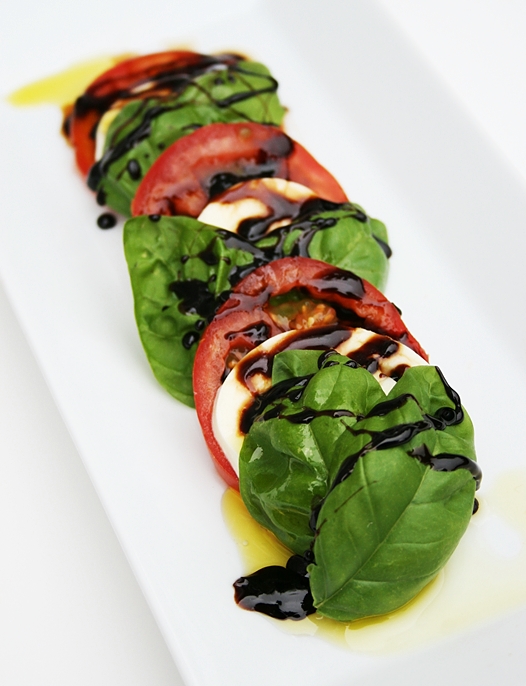
Reaping What You Sow: Caprese Recipe


One of my favorite salads is Caprese. It's really simple to make and incorporates a ton of flavors with five ingredients. The first thing I did with my tomatoes was make one of these salads.

Ingredients:

Basil
Whole Mozzarella (for slicing)
Tomatoes
Balsamic Glaze
Olive Oil

1. Slice your tomatoes, slice your mozzarella, and wash and pick your basil leaves off the stalks you cut.

2. Layer these ingredient. I like to go (from the bottom up) tomato, mozzarella, then basil.

3. Drizzle olive oil and balsamic glaze.

4. EAT!

Letting Grow and Letting Go.

After the Great Patio Debacle of 2010, the patio was freshly painted (the same shade as before) and I started work on the first of my crops. I bought a large whiskey barrel planter from Lowes (on sale of course) and planted Juliette tomatoes and strawberries together in the same pot. Tomatoes and strawberries are supposed to grow very well together so they are good plants to couple in one container. They also look pretty together because the tomato plant is tall and billowy and the strawberries cover the ground around the tomato nicely. I tucked a lattice behind the tomato plant between the table it was sitting on and the patio screen so that the plant could grow outward and still be supported.

The tomato is growing beautifully but a big fat gubby parasite killed my strawberries. It hid out under their leaves and ate away at it until I found the perp and read him the riot act.

I also planted a bell pepper plant and a hot pepper plant which were destroyed by spiders. This is what they looked like when they were beautiful.

I replanted all my herbs, basil (my favorite), rosemary, and oregano. I planted them all in the same pot with the oregano and basil at opposite ends, separated by the rosemary. Apparently, basil likes to be drowned and oregano prefers a dryer soil. By planting them this way I can easily cater to their preferences. Thank god for rosemary, my well-behaved, low maintenance child. I also found some nice Thai basil and put it in it's own pot. I'd like to get more varieties because there is a definite taste difference between the two.


Finally, I planted squash and cucumbers in a large pot together. They are good companion plants and are supposed to do well in containers. I didn't get the chance to find out because my cat almost immediately dug them up and left them dead and limp at the crime scene for me to find. They could have been so good.


Right next to the squash and cucumber is the fountain I made because I really like the sound of trickling water. It was really easy to assemble. I bought a nice pot, some rocks, and a container fountain pump (also from Lowes). After assembling the pump according to the directions, suction cupping the pump to the bottom of the pot, and adding rocks and water, I submerged a water lily in the bottom of the fountain. The pump can be a little testy but I've found that jiggling it around reinvigorates it when the spray gets limp...
ANYWAY, I learned several valuable lessons this go around.

1. Be very CAREFUL buying plants from chain stores. I was pretty impatient and just wanted to see some action on my patio so I bought some plants that were pretty far along in their growth from Lowes (I swear they are not sponsoring my blog, it's just the closest home and garden place to my apartment) and I know better. This was a mistake for a few reasons. You can't be sure the quality of the seed or the soil that your plants are in. They could also be grown from GM seeds, so you won't be able to preserve seeds from the plants you have grown for the next planting. They are also more likely to have pest stowaways that travel home with you, like my strawberries and peppers. For this reason, I have ordered some organic seeds online and plan on growing them from the proverbial ground up. Updates to come next.

2. Some plants were meant for hanging. I learned that vine-ing plants like squash that would normally spread out across the ground, do much better in hanging planters than regular containers because they can grow out much farther than a planter will allow. They also spend virtually no energy on strengthening their vines when they are hanging and all that energy goes into fruiting. That's next on my list. Once my squash sprouts, I will plant them in hanging planters. There is a great DIY Hanging Planter plan on CraftingAGreenWorld.com that I was going to make.However, I found some Topsy Turvies at target on sale for 3 dollars a piece which was cheaper than the bucket I would have needed to buy. I'm pretty skeptical of Informercial products, but I've heard they work and they are hilarious or ironic or something. Whatever.

3. Plants die and plans don't always work. Gardening teaches you to just let go when things won't grow.

Friday, July 9, 2010

Apartment living means putting your genius on hold.

I still don't have my worms. I keep saying, "next paycheck I will get my worms." It's hard to justify a $25 worm purchase when there is gas to be bought and bills to be paid. However, I recently spent $28 dollars on the Sims3 which is clearly unnecessary and shameful in light of my worm-less-ness.

We spent a good few hours recently rearranging the porch to free up optimal container gardening square footage. We were sweaty and covered in some sort of dusty sludge but very proud of the end result.

We patted ourselves on the back and sat down to absorb our accomplishment.
The next day, we came home to find a letter stuck under our door. The apartment management would be pressure washing and painting the outside of the building, including the inside of our patios, and we were required to clear the space completely to avoid any damage to our stuff. Two weeks later, they still aren't finished. Devi at the front office has estimated a finished product by Monday or Tuesday of next week, after which time we can finally get down to business. In the mean time, my plants-- which have been forced inside-- are looking rather sickly, partly because my routine was interrupted by the furniture upset and I forgot to water them for a while, and partly because they haven't been getting the proper amount of sunlight.

In the meantime, I've downloaded an APP for my iPod called "pottedgarden." It's pretty cute and perfect for a novice gardener because it provides a good amount of planting, watering, fertilization, pairing, pest control, and harvesting information about a limited number of fruits and vegetables. It makes information easily accessible if you have an iPod (an obvious problem for those people without). Yeah, there's really an APP for everything.

Seriously, I'm getting my worms very soon...I swear.

Monday, June 21, 2010

Introduction

Our apartment is located on the third floor of a large apartment complex that sits back in a "nature preserve". I'm not sure what the apartment complex itself (runoff, garbage, land use, etc) has done to the nature in our preserve but I'd be willing to bet it hasn't preserved so much as disturbed the flora and fauna. The landscaping does a pretty convincing job of disguising the fact that we are surrounded by strip-malls, interstate exit ramps, and probably the most poorly designed, traffic ridden road in Tampa bay.

I've become interested in the local food, organic food, and homesteading movements and started itching for some soil of my own to cultivate. However, my location makes this slightly impractical. I talked to a rep from our apartment complex about creating some sort of community garden but she said something about zoning and maintenance people, so I started looking for ways to grow food in containers in my apartment.

I began with a website: the very cool Windowfarming.org and a book by Maria Finn, A Little Piece of Earth: How to Grow Your Own Food In Small Spaces. The book is super accessible and even has illustrations for those of us who like a good picture to accompany our text. The important thing for me is to make the most of the limited space we have without crowding us out of our living space and to reduce our reliance on store bought produce. I'm an avid cooker so cultivating my own ingredients is an exciting next step in my quest the for ultimate fresh flava.

My first step will be to start composting. After work today, my boyfriend and I are going in search of a table top composter, the next step will be procuring a sack of live worms who will eat and poop my kitchen waste into a fabulous, nutrient rich sludge for my plants.